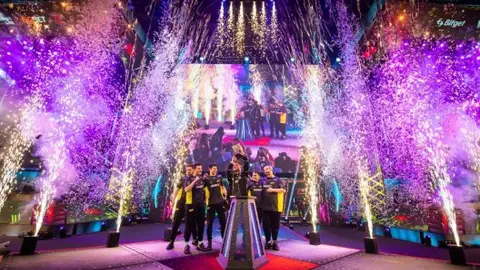
You have the itch. Not the itch to watch Worlds from the sofa, the itch to queue a ranked game, lose it, queue again and check your rank at 2 AM. This list is for that person. A competitive game earns a place here when its ladder is worth your hours: a skill ceiling you will never touch, matchmaking that finds a fair lobby at your rank, and a publisher-backed circuit at the top so the grind leads somewhere. The best esports games in 2026 are not the ones with the loudest marketing. They are the ones where a random Tuesday-night match still teaches you something. Ten titles follow, each with what it demands mechanically, how its ladder is built, what it costs to start and roughly how long until you stop feeling lost. Competitive esports is a big tent. Pick the corner that fits your week.
What Makes the Best Esports Games Worth Grinding (and How This List Was Ranked)

Every esports title on page one of Google gets described as a thriving competitive scene. That is not true, and anyone who has queued Heroes of the Storm lately knows it. So this ranking leans on five checks, each with a 2026 signal behind it.
- Skill ceiling. Easy to learn, hard to master, with a gap between a Gold player and a pro that a spectator can see.
- A real ranked ladder. Visible rating, sane placements, and party restrictions at the top so high-rank games stay honest.
- A player base you can queue into. Peak concurrent players in 2026 from Steam and platform data, not lifetime downloads.
- Publisher-backed competition. A circuit the developer funds and schedules, with esports organizations and esports teams committed to it.
- Prize pool and viewership as proof of health. Money paid out in 2026 and peak viewers on Twitch and YouTube, dated wherever a number appears below.
The competitive landscape moved since last year's lists. Overwatch dropped the "2" from its name in February, VALORANT has just finished the final season of its franchised league before open qualifiers return in 2027, Counter-Strike set an all-time viewership record in Cologne, and the Esports World Cup paid out $75 million across 24 games in Paris this summer. Dota 2's International is still a fraction of its 2021 size. The biggest esports by audience are not always the deepest ladders, and the order below weighs both.
The ranks behind the opinions: Emerald in League solo queue, Level 7 on FACEIT, Champion 2 in Rocket League doubles, Diamond in Street Fighter 6 on Ken, and a VALORANT Diamond peak I have not seen since 2024. The hour estimates per game are mine, assume some shooter or MOBA background, and assume you actually review your losses.
The Top 10 Esports Games to Play in 2026

The five biggest ladders side by side first, because these are the ones most people are choosing between. Look hard at match length: a Dota 2 evening and a Rocket League evening spend the same hour very differently.
|
Game |
Genre |
Team format |
Platforms |
Typical match |
Flagship prize pool |
|
League of Legends |
MOBA |
5v5 |
PC (Windows, macOS) |
25-35 min |
Worlds 2025: $5,000,000 |
|
Counter-Strike 2 |
Tactical FPS |
5v5 |
PC (Windows, Linux) |
35-45 min |
IEM Cologne Major 2026: $1,250,000 |
|
VALORANT |
Tactical hero shooter |
5v5 |
PC, PS5, Xbox Series X/S |
35-45 min |
Champions 2026: $2,250,000 |
|
Dota 2 |
MOBA |
5v5 |
PC (Windows, macOS, Linux) |
35-50 min |
The International 2026: $3,355,417 |
|
Rocket League |
Vehicular sports |
3v3, 2v2, 1v1 |
PC, PlayStation, Xbox, Switch |
5 min plus overtime |
RLCS 2026 World Championship: $1,200,000 |
1. League of Legends: The MOBA That Still Sets the Standard

Genre: multiplayer online battle arena, 5v5, three lanes, 170-plus champions. Mechanics matter, but the real skill test in the MOBA genre is information: minimap glances every few seconds, tracking enemy Flash and ultimate cooldowns in your head, and reading a wave state to know when you can leave lane. Worlds 2025 peaked at 6.75 million concurrent viewers for the T1 versus KT Rolster final, the second-largest esports audience ever recorded, with $5 million on the line. Worlds 2026 runs 15 October to 14 November across Los Angeles, Texas and a Barclays Center final in New York, with the Riot Games regional leagues feeding it.
Ladder: five placement games, decay starts at Diamond, and since patch 26.15 Master players can duo again while Grandmaster and Challenger queue solo. Solo-queue viability is excellent, the game is free, and Gold takes roughly 300 hours.
2. Counter-Strike 2: The Purest Test of Aim and Economy

Genre: tactical first-person shooter, 5v5, no abilities. Every round is spray control, crosshair placement, a smoke or flash thrown at the right second, and a buy call the whole team agrees on in fifteen seconds. The 1v3 pistol clutch is still the defining pressure moment in esports history. The scene is at its healthiest ever: the IEM Cologne Major in June 2026 peaked at 2.75 million viewers, the most-watched Counter-Strike event on record, with Team Falcons sweeping FURIA for the $1.25 million pool, and PGL's Singapore Major follows in late November. Steam counted 1.86 million concurrent players in April 2025.
Ladder: Premier reveals a numeric CS Rating after ten wins, Prime status ($14.99, one-time) is the real entry fee, and serious players graduate to FACEIT levels 1 to 10. Solo queue holds up to about 15,000 rating. Mid-Premier takes 400 to 500 hours.
3. VALORANT: Tactical Shooting With an Ability Layer

Riot's tactical shooter keeps the Counter-Strike skeleton (5v5, spike sites, low time-to-kill, a buy economy) and layers around 30 agents on top, so utility replaces memorised smoke lineups and the gunplay forgives a little more. Roles give you a job on day one: Duelist, Controller, Initiator or Sentinel. VALORANT Champions 2026 ran in Shanghai from 24 September to 18 October for $2.25 million, and LOUD beat Team Vitality 3-1 in the final to become the first organisation to win Champions twice. It was the last event of the franchised era before the VCT moves to open qualifiers in 2027, which is the best news a grinder has had in years.
Ladder: five placements, visible Rank Rating over hidden MMR, no decay except that Immortal and Radiant leaderboard spots need a match every seven days. Immortal and above queue solo, duo or as a full five. Also on PS5 and Xbox with a separate ranked pool. Free. Gold in about 200 hours.
4. Dota 2: The Deepest Strategy Ceiling in Esports

Defense of the Ancients grew into the densest of the MOBAs: every one of 120-plus heroes free from install, creep denying, couriers, a day-night cycle, items that redefine a hero, and matches that regularly pass 45 minutes. Among strategy games it is the closest thing to chess played by a team. The honest scene note: The International 2026 in Shanghai paid out $3.36 million, and Team Spirit won a record third Aegis in a 3-2 final in front of a 1.8 million-viewer peak. Strong for most games, and a fraction of the $40 million that made TI 2021 the largest prize pool in esports.
Ladder: 100 unranked hours and a phone number before ranked unlocks, then ten calibration games, with one recalibration a year. Ranked uses a single MMR with smaller swings for party games, so climbing alone is fully supported. Free. Legend takes about 500 hours.
5. Rocket League: Mechanical Skill With No Downtime

Car football with a physics engine that rewards ten thousand hours: aerials, air dribbles, flip resets and the rotation discipline that separates Champion from Grand Champion. Matches last five minutes plus overtime, there are no cooldowns and nowhere to hide. With 1v1, 2v2 and 3v3 all ranked, it is the most solo-friendly team game here. The Rocket League Championship Series 2026 ended in Fort Worth (15 to 20 September), with $1.2 million for 20 teams out of a $6.1 million season and Team Falcons sweeping Spacestation Gaming 4-0 in the grand final, and Epic Games now pushes all net sales of a World Championship bundle into the pool.
Ladder: ten placements per playlist each season, 22 ranks up to Supersonic Legend, full crossplay on PC and console with a controller as the standard input. Free. Diamond in roughly 250 hours, Champion past 400.
6. Fortnite: Build Fights and the Biggest Payouts in Battle Royale

Epic's battle royale asks you to shoot, build, edit and shoot again inside two seconds, and Zero Build ranked exists, with its own rating, for players who bounce off construction. Last one standing still decides it, but build fights decide who is standing. FNCS 2026 pays over $10 million across a duos season, and the Global Championship in Antwerp, Belgium, on 26 and 27 September split $2 million between 50 duos. The 2019 World Cup's $30 million pool remains the precedent everyone cites, and a 16-year-old took $3 million of it.
Ladder: eight tiers from Bronze to Unreal, separate ratings for Build, Zero Build and OG, and a seasonal reset that clears the visible rank while hidden skill carries over. Solo ranked is fully supported and 1v1 build fights are the training ground. Free, on everything. Diamond in 150 to 200 hours.
7. Call of Duty and Warzone: Fastest Reactions Win

Competitive Call of Duty is 4v4 at sub-second time-to-kill on objective game modes: Hardpoint, Search and Destroy, Control. The CDL runs on PC with controllers mandated, and its 2026 Championship in Las Vegas paid $2 million in July, with a separate $1.8 million Black Ops 7 event at the Esports World Cup. Warzone is the battle royale shooter variant with its own ranked playlist. The genuine cost: Black Ops 7 arrived in November 2025, Modern Warfare 4 launched on 23 October 2026 at $69.99, and the pro scene migrates with it. Commit to CoD and you buy a new game every autumn.
Ladder: skill rating from Bronze to Top 250, seasonal resets, CDL rulesets. Warzone ranked works solo; the 4v4 ladder rewards a squad. PC and console. Crimson in about 150 hours.
8. Apex Legends: Movement, Rotations and Squad Play

Titanfall movement (tap-strafes, wall bounces, superglides), legend abilities and three-player squads make Apex the highest-skill battle royale to actually play, and rotations win more games than aim. The Apex Legends Global Series Year 6 carries a $7 million pool with $2 million at each international, PC-only at pro level. The straight talk on 2026: Steam averages sit near 100,000 concurrent, the March season launch peaked at 287,000, well below the 624,000 record of 2023, but the 2024 slide has flattened and console players remain more than half the base. Queues are still fast on every platform.
Ladder: trios only, Predator capped at the top 750 per platform, hard resets each split. Solo queue is playable to Diamond; Master wants a duo you trust. Free, PC and console. Diamond in about 300 ranked hours.
9. Street Fighter 6: The Best 1v1 Entry Point in the FGC

Modern controls put specials on one button at a 20 percent damage penalty, which is the deal Capcom uses to get you through the door. The real fighting game is frame data and reads, a mental chess match of conditioning, whiff punishes and Drive Impact bait. Capcom Cup 12 at Ryogoku Kokugikan in March 2026 paid a $1 million prize to its winner from 48 world tour qualifiers, Capcom Cup 13 keeps that figure, and Street Fighter 6 topped the Evo Championship Series for a fourth straight year with 2,414 entrants. Nobody else can lose a match for you.
Ladder: ten placements per character, League Points to Master, then a visible Master Rating. Solo by definition. The game runs $20 to $60 depending on sale, a leverless controller or stick adds $100 to $200, and Diamond arrives around 200 hours.
10. Overwatch (Formerly Overwatch 2): Ability Tracking Under Chaos

The "2" came off the name on 10 February 2026 with five new heroes, and Stadium dropped to balance-only updates in July after just 6 percent of players used it. Season 4 (August) then added the tank D.Mon and a new Emerald rank between Platinum and Diamond, and Season 5 (October) added the support Doctrine and moved Sombra to Support. The core is intact: a 5v5 hero shooter with role queue, and the skill nobody teaches is ultimate tracking, counting enemy charge while six abilities fire at once. OWCS is the competitive community's circuit now that the Overwatch League is gone; the Tokyo Champions Clash ran for $250,000 and the World Finals in China from 2 to 6 December use a crowdfunded pool that reached $500,000 in 2025.
Ladder: ten placements, then rank moves after every match; Master can only group within one tier and Champion queues solo or duo. Solo queue is fine to Diamond and painful above it. Free, PC and console. Diamond in 250 hours.
Also Worth Your Time: PUBG, Super Smash Bros, Strategy Games and Mobile

Ten slots is a hard cap, not a verdict on the rest of the esports community.
- Rainbow Six Siege X: destructible walls and floors make it the hardest FPS to read. The Six Invitational 2026 in Paris paid $3 million and FaZe took it. Free-access version since 2025, but high ranks realistically need a five-stack.
- PUBG: Battlegrounds: the tactical original, still above a million Steam players at its March 2026 peak, with PGC 2026 in Istanbul this December for $1.5 million-plus.
- Super Smash Bros. Ultimate: grassroots-run on the Nintendo Switch under Nintendo's community tournament guidelines, so it lives on entrants rather than publisher money.
- Mobile esports tournaments: Mobile Legends: Bang Bang's M7 World Championship hit 5.68 million peak viewers in January 2026, the biggest mobile audience ever; the Free Fire World Series feeds a global esports circuit that peaked at 802,000 at the Esports World Cup; Clash Royale and Clash of Clans keep the card games and tower defense crowd competing on a phone.
- Strategy games and auto-battlers: StarCraft II remains the purest 1v1, and Teamfight Tactics had a $500,000 pool at the Esports World Cup.
- Marvel Rivals: the 6v6 hero shooter's Ignite circuit guarantees $3 million a year.
The cautionary tale: Team Fortress 2 competitive survives only through community leagues, and Heroes of the Storm lost its pro circuit in 2018 and never got it back. Scene health is a selection criterion because a dead ladder means 20-minute queues and smurfs.
How to Pick the Competitive Gaming Ladder You'll Actually Commit To

Match the genre to what you enjoy watching yourself do. If you replay your own clutch, you are a tactical shooter player. If you replay a team fight, you want a MOBA game. If you replay a single aerial, Rocket League.
Then count hours honestly. A casual player with five hours a week gets more from Rocket League or Street Fighter 6, where every 30-minute session is a full unit, than from Dota 2, where one bad draft costs 50 minutes.
Solo-queue reality: Street Fighter 6, Rocket League 1v1 and 2v2, VALORANT and CS2 Premier are climbable alone to high ranks. Rainbow Six Siege and Overwatch above Diamond realistically require a stack, and most gamers who quit a team game quit for that reason.
PC and console: Rocket League, Fortnite, VALORANT and Apex run real console ladders. League, CS2 and Dota 2 are PC only.
Total cost beyond the free download: $14.99 for CS2 Prime, $100 to $200 for a fighting-game controller, a Switch plus subscription for Smash, and roughly $70 every October for Call of Duty.
No web3 game made this list, and that is deliberate. The 2021 play-to-earn wave mostly fizzled, and the survivors, Shrapnel's extraction shooter and Illuvium's auto-battler among them, lack the player counts and ranked depth to compete with anything above. If you are curious which ones still have a pulse, Eneba keeps a running guide to the best nft games 2026 that works as a reality check next to the numbers here.
Then pick one. Every rank listed earlier came from a season where I played a single game; the seasons I split across three multiplayer games produced nothing. In competitive gaming, grinding one ladder beats sampling five, and that focus is the only competitive edge that costs nothing.
Frequently Asked Questions
How many hours a day do pro esports players actually practice?
T1's League players have described two scrim blocks, roughly 1 to 4 PM and 7 to 10 PM, with solo queue in the gap and individual practice after, which lands between 10 and 12 hours a day in season. For an amateur the useful number is smaller: top players agree that two focused hours with VOD review beat six on autopilot.
Is Counter-Strike 2 harder to learn than VALORANT?
Yes, and it is not close. CS2 has no ability layer to cover a bad peek, its spray patterns punish more, and Premier hides your CS Rating until you have ten wins. VALORANT shows a rank after five placements and its agents hand you a job on day one. Most players reach a comparable ladder midpoint in VALORANT in about half the hours CS2 asks for.
Which of these games have a real console competitive scene?
Four do it properly. Rocket League's RLCS is fully cross-platform and controller-native. FNCS qualifiers are open to console and PC. Capcom Cup plays Street Fighter 6 on PlayStation 5. Call of Duty's CDL is PC-only but mandates controllers, and its Challengers tier accepts console entrants. OWCS and ALGS are PC-only, and VALORANT's console ranked has no publisher-run pro circuit yet.
How do you find a team once you're serious about competing?
Use the in-client path first: VALORANT Premier is a five-person team mode that feeds into Challengers, and League's Clash runs weekend brackets. For CS2, FACEIT hubs and ESEA leagues are where rosters actually form. RLCS open qualifiers accept any registered trio. From 2027, the VCT Kickoff in each region reserves four of twelve slots for open-qualifier teams, the first real door for unsigned rosters in years.